
New articles published in the Journal of Geoethics and Social Geosciences: geosciences in television and film; AI in Africa and geopolitics; case studies from Brazil
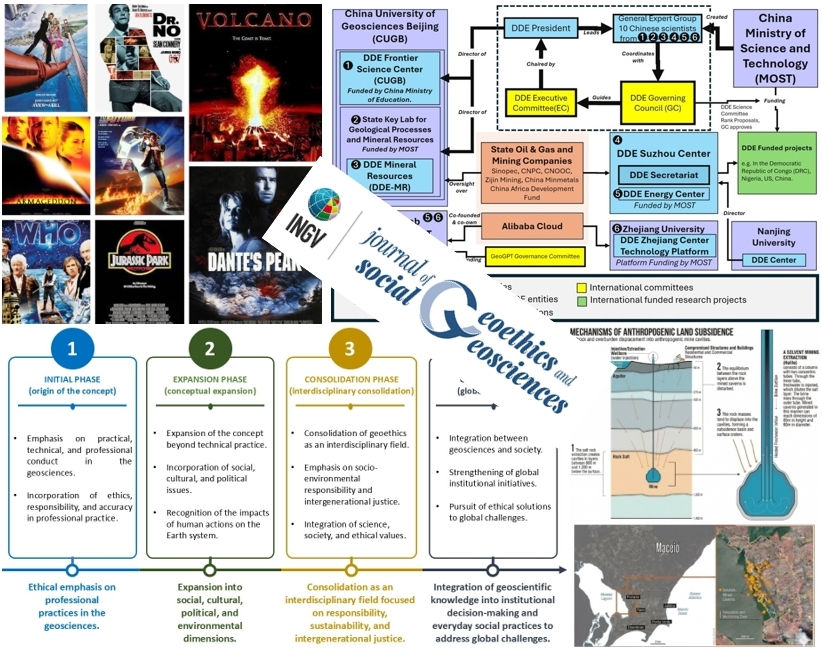
The Journal of Geoethics and Social Geoscience (JGSG) published several new articles in the Issue 1(2), 2026.
We remind you that this journal is diamond open access. No Article Processing Charge (APC) is requested to authors and no fee to readers.
These new articles can be freely download and can be cited as follows:
Piazza M.C. (2026). Geosciences in Italian and International television and film fiction: a study on dramaturgy, semiotics, and ethics of narrative models. Journal of Geoethics and Social Geosciences, 1(2), 1-33. https://doi.org/10.4401/jgsg-120
Abstract:
This study analyses the representation of the geosciences in Italian and international audiovisual fiction, investigating how films and television series contribute to shaping public perceptions of science, natural hazards, and scientific institutions from an ethical perspective. Adopting an interdisciplinary approach that integrates Media Studies, semiotics, ethics, and the sociology of science, the study examines a corpus of Italian and international productions spanning from the twentieth century to the present day.
The research is intended as both a methodological and an exploratory contribution, proposing a framework for the analysis of the geosciences in audiovisual fiction and illustrating its application through selected case studies.
The findings reveal a significant evolution in narrative models: from the Hollywood tradition, characterized by catastrophism and the figure of the isolated “Cassandra scientist,” to more realistic and institutionally grounded representations in recent Italian productions. Contemporary films and television series increasingly portray the geoscientist as a “competent hero,” closely connected to local communities and actively engaged in disaster risk prevention, communication, and management.
The study also explores how these narratives may shape the ethics of public engagement with science, contributing to bridge the gap between the scientific community and society while redefining the cultural role of the geosciences in the Anthropocene. Through a dramaturgical and semiotic analysis of selected films and television series, the study argues that contemporary Italian narratives humanize scientists, promote a culture of prevention, and frame disasters as shared social and cultural challenges rather than as inevitable consequences of natural hazards.
This work lays the foundation for future research on the role of audiovisual narratives in fostering prevention, strengthening the ethical communication of geoscientific knowledge, and enhancing dialogue between science and society.
Keywords:
Geosciences in the Media, Geoethics, Science communication, Environmental storytelling, Disaster and climate fiction, Public engagement with science
Free download:
___________
Cleverley P.H., Errami E., Marshall T.R., Burnett S., Lator A.O., and Ebuka I. (2026). Open at the interface, closed at the core: neutrality claims in AI-enabled geoscience infrastructure focusing on Africa - The case of Deep-Time Digital Earth and GeoGPT. Journal of Geoethics and Social Geosciences, 1(2), 1-49. https://doi.org/10.4401/jgsg-119
Abstract:
Geological data has become strategic infrastructure for resource assessment, investment negotiation, and economic sovereignty. Remotely hosted big data and Artificial Intelligence (AI) platforms are increasingly promoted for geoscience in the Global South, particularly Africa. Whether such platforms are genuinely geopolitically unaligned, and how this can be verified, has direct implications for scientific autonomy and data sovereignty.
Using Deep-time Digital Earth (DDE) and GeoGPT as a critical case, this paper examines whether claims of geopolitical non-alignment can be independently verified. DDE was suspended by its founding body, the International Union of Geological Sciences (IUGS), in early 2025, yet its non-alignment claims have continued. Drawing on UNESCO Open Science and AI Ethics frameworks, the paper assesses three criteria: governance independence, data and software openness, and AI transparency.
The analysis reveals a distinction between user-interface accessibility and core technical verifiability. Core DDE/GeoGPT software remains proprietary, and the platform and models diverge from definitions of ‘openness’ and ‘digital public goods’ established by UN-backed frameworks, and the AI Ethics Recommendations from UNESCO. The documentary record also shows governance and funding concentrated in a single national jurisdiction, including links between DDE collaboration targets and China’s Belt and Road Initiative, a 2026 agreement with the mining investment department of the China-Africa Development Fund, and advisory structures that include individuals with documented affiliations to the national resource-extraction sector. Combined, their significance lies in the gap they create between the platform's claims and what can be independently verified.
AI governance documentation discloses filtering of content deemed politically sensitive; in one documented instance, a response citing peer-reviewed research on state censorship was replaced by a refusal. The criteria and scope of this filtering are not fully disclosed, leaving it un-auditable.
The paper concludes that it is currently not possible to verify claims of non-alignment using this framework; DDE/GeoGPT is best characterised as what we term a state-anchored international platform: globally participatory, but dependent on a single national jurisdiction. The criteria provide a transferable test for comparable claims and highlight the importance of calibrated engagement with external platforms, and use of open-source and sovereign alternatives where privacy or geological data sovereignty is at stake.
Keywords:
Geoscience, Geology, Geodata, Geospatial, Africa, Energy transition, Critical minerals, Oil and gas, Artificial Intelligence, Data sovereignty, AI ethics, Geoethics, Geopolitics, Cyberinfrastructure, Science diplomacy
Free download:
___________
da Silva Lima F., Jorge M.doC.O., Fernandes M.doC., and Guerra A.J.T. (2026). Conflicts between mineral exploration and environmental conservation: an analysis of the dual role of geoscientists considering geoethics. Journal of Geoethics and Social Geosciences, 1(2), 1-29. https://doi.org/10.4401/jgsg-117
Abstract:
Historically, mineral exploration, prospecting, and extraction have been subjects of debate, with positions ranging from endorsement to criticism. In Brazil, these activities date back to the colonial period and intensified particularly from the 1940s onward, driven by the commercial exploitation of mineral resources and petroleum. In the early 21st century, technological advances expanded extraction and increased the demand for new port terminals in response to the intensification of international trade and changes in global logistics. This context has generated conflicts between the production and transportation of mineral resources and environmental conservation. In recent decades, geoscientists have emphasized that the impact of human activities on Earth already exceeds that of natural forces. In this scenario, the article analyses the tension between mineral extraction and conservation, highlighting the dual role of geoscientists in light of geoethics. To this end, two case studies are examined: mining in the Quadrilátero Ferrífero, focusing on Serra do Curral in Minas Gerais State, and the debate over the construction of a port terminal in Ponta Negra, Rio de Janeiro State. These cases highlight the need for a geoethical approach, throughout the entire production chain, including legal aspects and intergenerational rights.
Keywords:
Geoethics, Geosciences, Environmental conservation, Mining, Oil exploitation, Global logistics, Intergenerational justice
Free download:
___________
Alves-Brito A. and Rocha-Júnior E. (2026). The Braskem case in Maceió, Alagoas: socioenvironmental issues with historical, ethical, and philosophical implications for geoscience education and outreach. Journal of Geoethics and Social Geosciences, 1(2), 1-30. https://doi.org/10.4401/jgsg-115
Abstract:
Braskem is one of the world’s largest petrochemical corporations and among Brazil’s most profitable companies, operating for decades in the city of Maceió, state of Alagoas, in northeastern Brazil. Beginning in the 1970s, Braskem conducted halite mining in Maceió, which culminated in 2018 in one of the most severe socioenvironmental crises in recent history: ground subsidence across five neighborhoods within a 3.6 km2 area, directly affecting approximately 60,000 people. Since then, specialized literature has produced a range of analyses of the event and its socioeconomic consequences; however, none have focused on the historical, geoethical, and philosophical implications for geoscience education and science communication. Drawing on primary Brazilian sources, most notably the Parliamentary Inquiry Commission’s final report on Braskem and video recordings of its hearings, we (i) develop theoretical discussions concerning the role of the geosciences in the world informed by decolonial conceptions of science, and (ii) offer practical recommendations for curricula and science–art pedagogies that cultivate a more critical geoscience, attentive to our deep interrelations with planet Earth. From a history‑and‑philosophy‑of‑science perspective, the Braskem case in Maceió enables reflection on conceptions of history, nature, and the philosophy of science, and — through case study analysis — expands dialogue about how sciences, particularly the geosciences, are defined and operate in ways that can both mitigate and exacerbate socioenvironmental and socioeconomic inequalities. Between theory and practice, we also reflect on the subjective responsibilities of geoscientists, science communicators, and institutions in confronting the destructive logics of scientific and technological development entangled with death politics, colonialism, and capitalist patriarchy, with historical, ethical/geoethical, and philosophical implications for the geosciences at global scale.
Keywords:
Geosciences, Science education, Science communication, Braskem, Geoethics
Free download:
IAPG - International Association for Promoting Geoethics:
IUGS - Commission on Geoethics:
EGU - Geoethics Working Group:
CIPSH - Chair on Geoethics:


Comments